VoyagerSight
A research project replicating NVIDIA's Voyager and giving its Minecraft agent sight, to test whether LLM agents play better when they can see
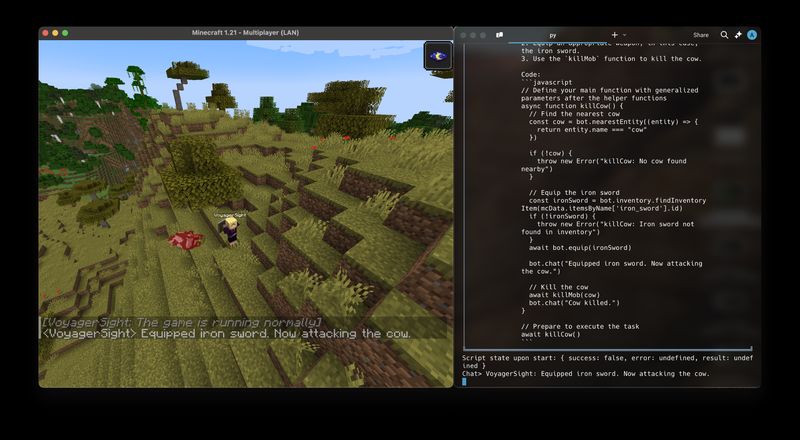
Table of Contents
VoyagerSight is a research project that replicates NVIDIA’s Voyager and gives its agent sight. Voyager was one of the first papers to show an LLM agent learning open-endedly in Minecraft. Its agent only ever reads text about the world, and newer models can see, so I wanted to know whether an agent that can look at the world plays better.
I worked on it alone from October to December 2024, using Claude 3.5 Sonnet, Claude 3 Opus, and GPT-4o.
Technologies Used:
- Python
- LangChain
- ChromaDB
- Anthropic and OpenAI models
- Mineflayer
- Pandas and Google Colab
How It Works
Voyager’s agent runs a loop. A curriculum proposes the next task based on what the agent has and has done. The agent writes JavaScript against the Mineflayer bot API to do it, runs the code in the game, and reads back chat messages, errors, and the state of the world. It revises the code until the task succeeds, then saves the working function to a skill library it can call from later code.
I rebuilt that loop on newer models, including Voyager’s skill retrieval, which stores skills as embeddings in ChromaDB and pulls the most relevant ones into the prompt for each task. Then I added two things:
- Sight. Each prompt includes a screenshot from the agent’s point of view alongside the text observations, so it can plan from what it sees.
- Ablations. I ran the same tasks with vision on and off, on both newer models and the ones Voyager originally used, to isolate what sight adds.
Results
Sight helped no matter which model was underneath. With vision on, agents unlocked more achievements, survived longer, and progressed further.
The more interesting result was how they played. Text-only agents took similar actions at similar steps run after run. Agents that could see varied much more in what they decided to do, so their runs looked less alike.
What I Learned
Most of what I took away was about agents in general, not Minecraft. An agent’s behavior comes as much from its prompt and memory design as from the model. The feedback loop of running code, reading errors, and retrying did more for reliability than a stronger model did. And evaluating an agent fairly is hard. I use those lessons in the agentic engineering work I do today.